
Art Learning Center
 |
 |
Watercolor Still-life Demonstrations
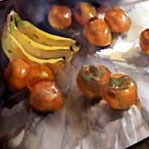 |
Medium: Watercolor Painting There are many different ways to begin a watercolor painting. In this demonstration, I started the painting from the main subjects which are the bananas, the mandarin oranges and the persimmons. I first put yellow into the area for the bananas, then I mixed yellows and reds to define the areas for the mandarin oranges and the two persimmons. As you may noticed, I left some blank areas within the oranges and the persimmons which will be used for the highlights and leaves of the fruits... |
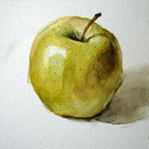 |
Medium: Watercolor Painting Lesson highlight: In this watercolor demonstration, you will learn how to capture the light and shadow of a green apple. You will learn to focus on the value of the color, and learn how to paint layer by layer of colors, and step by step to build-up the value and forms of this simple still-life. |
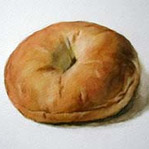 |
Medium: Watercolor Painting Lesson highlight: In this watercolor demonstration, you will learn a technique creating surface texture by using glazing and lifting-off techniques. Bagels have a soft surface. Through this demonstration, you will learn how to capture the feel of the surface of a bagel, colors and the very fine details with these simple techniques. |
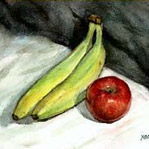 |
Medium: Watercolor Painting Lesson highlight: In this watercolor demonstration, you will learn how to arrange a still-life setting for a watercolor painting. Composition as important as the value study in a still-life painting. In this demonstration, we are putting two different kinds of subjects together in a setting. The colors and values in these objects are different. This will add a new challenge and dimension. We will see the setting as one subject and the balance between the objects in the setting as another. |
Watercolor Portrait Painting Demonstrations
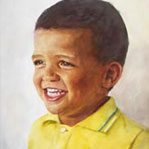 |
In this watercolor portrait painting demonstration, Yong showed you how he step by step painting process from start to finish. With mostly red and burnt umber, he worked into the middle tones. he didn't stay working in one area for long. Yong usually spend 10 seconds here, then 10 seconds there. It is important to keep your attention on the overall painting, paying attention to the color temperature and balance while you work into the smaller areas... |
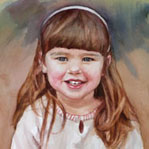 |
Medium: Watercolor Painting For a portrait painting, I usually start with a good pencil drawing. This is the step where I plan the composition, sort out the perspective, relationships, proportion and balance, size and distance. A good drawing is a good base for a painting; it can give you more confidence, so take as much time as you need to in this step... |
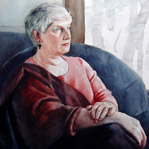 |
Medium: Watercolor Painting Lesson highlight: In this watercolor demonstration, you will learn how to step by step from gathering reference materials, sketch, to finish a watercolor portrait painting. When painting a portrait, it is most important to know the subject. To do this, I visit her in her home in order to understand her family, her personality, and listen to her stories... |
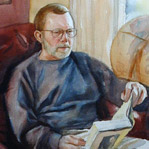 |
Medium: Watercolor Painting Lesson highlight: In this watercolor demonstration, you will learn how to start a watercolor portrait painting from "born" and "dry". I did a few preliminary drawings and decided on the final concept and design for the portrait. I also took a number of high-resolution digital photos. Back in the studio, I started the painting process by drawing a likeness of the subject, using a 2H pencil on high-quality watercolor paper. |
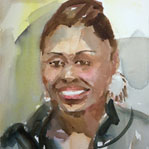 |
Medium: Watercolor Painting after I had the tones and color balance settled, now I further defined the shapes and darker area of the eyes, nose, mouth and others. With a another fine-toning touch and adjustment to the color temperatures, this quick water color portrait painting finished in about 20 minutes... |
Watercolor Landscape Painting Demonstrations
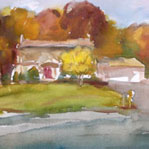 |
Medium: Watercolor Painting Color Study is a process of experimental color composition and value arrangement. It is especially helpful when you need to combine two or more reference pictures for a painting. For example, in my recent watercolor painting commission, my reference pictures were two photos of maple trees, and a picture of a morning scene of the house... |
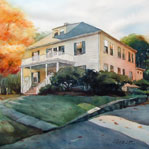 |
Medium: Watercolor Painting Lesson highlight: When the sky area was dry, I started painting the front of the house. First, I applied some yellow color to the left side of the house, and continuously washed the rest of the wall with a mixture of blue and burnt sienna. For the other side of the house next to the red maple tree, I started from the left upper corner with yellow and added more and more red towards the lower right corner of the wall.... |
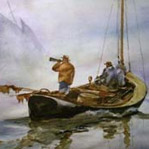 |
Medium: Watercolor Painting (This free step by step watercolor lesson provided by Mary Churchill) Make a strong drawing. If you have weak drawing skills, you can make Division marks vertically and horizontally with a pencil on both your photo if you are using one, and your paper. Use LIGHT markings since you will want to remove these later. There is no need to erase your drawing though. |
Children's Book Illustration
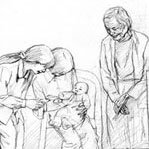 |
As you may already knew, Yong Chen is a children's book author and illustrator. Here he showcased his process of creating illustration for a picture book by using one of his illustration in the book "Finding Joy"... When I received the manuscript from my editor, I started to read the story many times, then the story became a movie in my brain. The people with ages, locations, and emotions. Then I used a big piece of drawing paper and started sketching, to turn the movie floating in my mind down on my drawing paper, from scene to scene... |
Floral Painting Demonstrations
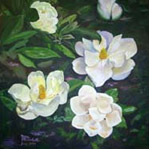 |
Medium: Watercolor Painting (This free step by step watercolor lesson provided by Mary Churchill) Tape your paper to the board with masking tape. You can either use a table and prop your board somewhat, or an upright easel. Choose a photo. (If possible), make Division marks Vertically and horizontally. Mark your paper in the same manner but use LIGHT markings ( you will want to remove these later). You may want to use this method until your drawing skills are strong to avoid frustration and a sense of failure. My students use Professional Products to avoid disappointments. |
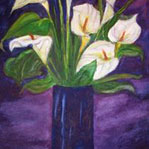 |
Medium: Watercolor Painting (This free watercolor lesson provided by Mary Churchill) Using a large brush, I start with the background to get color on the paper. Determine which side the light will come from. Remember that shadow is the action of light. Don't be afraid to use color. I use several colors on my brush at the same time since all things are made up of its' own color and reflected colors. You will use many layers of paint on your finished painting... |
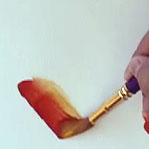 |
In this watercolor technique demonstration, Yong shared with you a brushwork rendering with blending two colors together in the same brush. Using a round brush with medium among of water, first get the yellow up to the middle part of the brush, and take the red only with the tip. He lay the brush about 10-degree angle from the paper surface, and move it slowly. A beautiful blend of colors, from red, orange, to yellow has been created with one stroke... |
Watercolor Painting for Gift Cards
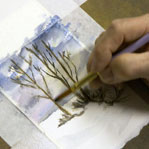 |
(This lesson provided by Mary Churchill) We at YongChen.com want to help you make your holiday cards original, wonderful and memorable. |
 |
(This lesson provided by Mary Churchill) |
 |
(This lesson provided by Mary Churchill) |
 |
(This lesson provided by Mary Churchill) |